Search please

Custom Search

Labels

Showing posts with label culinary. Show all posts

Thursday, January 12, 2012

Tape (tapai)


Tapai (often spelled as tape) is one of Indonesian traditional foods produced from the fermentation process (fermentation) of carbohydrate foods, such as cassava and rice. Tapai can be made from cassava (manioc) and the result is called fermented cassava. When made ​​from sticky rice or glutinous black and white, the result is called "fermented sticky rice" or "fermented sticky rice". Fermented in the fermentation process, used several types of microorganisms such as Saccharomyces cerevisiae, Rhizopus oryzae, Endomycopsis burtonii, Mucor sp., Candida utilis, Saccharomycopsis fibuligera, Pediococcus sp., And others. Tapai result of fermentation of S. cerevisiae are generally semi-liquid form, taste sweet acidity, alcohol, and has a sticky texture. Generally, fermented manufactured by small and medium industries as a snack or dessert.

Thursday, February 24, 2011

Ayam Betutu


Betutu is a side dish made from chicken or duck a whole that contains spices, then roasted in the husk fire. This Betutu has been known throughout the district in Bali. One of the producers goby is Melinggih village, Gianyar regency kecamatam Chedi. Chicken goby is also a special food Gilimanuk. Goby is used as a serving in religious ceremonies and rituals as well as dishes and sold. Consumers not only the people of Bali but also foreign visitors who come to Bali, especially in certain places such as in hotels and restaurants / restaurant. Betutu not stored longer lasting.

Kerak Telor


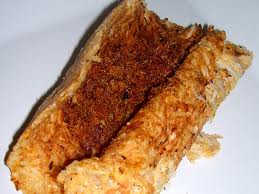
Kerak Telor is a Betawi traditional spicy omelette dish in Indonesian cuisine. With the ingredients of white glutinous rice, chicken egg, ebi (dried shrimp marinated) plus dry roasted shallots fried, then given a refined flavor of roasted coconut, red chilies, kencur, ginger, pepper grains, salt and sugar.

Batagor ( Bakso Tahu Goreng)


Batagor is typical foods originated from Bandung, which is made from starch, tofu and peanut sauce cucumber wear.

In Bandung, the seller Batagor are found at the edges of the street, at school, on campus, even in the restaurant there.


Material from this Batagor tofu is filled with a mixture of aci (tapioca flour) and the mill of mackerel fish. Batagor always accompanied by lively sematinya loyal friend that is dumplings made from made from a mixture of aci (tapioca flour) and fish meat tengiri but wrapped in dumpling skin.

Tuesday, February 15, 2011

Martabak


Murtabak, also Martabak or Mutabbaq, (Arabic: مطبق‎) is a stuffed pancake or pan-fried bread which is commonly found in Saudi Arabia (especially the Hejaz region), Yemen, Indonesia, Malaysia, Thailand, Singapore, and Brunei. Depending on the location, the name and ingredients can significantly vary. The name mutabbaq (or sometimes mutabbag) in Arabic means "folded".

In Malaysia, where it is called "Murtabak", it is sold by Mamak salesmen, and usually includes minced mutton, along with garlic, egg and onion, and is eaten with curry sauce. Murtabak also usually includes mutton in Yemen. In Indonesia, particularly Jakarta, it is called "martabak", and has two versions: a sweet one, and a savory one.

History

Murtabak originated in India, during the Delhi Sultanate (1206-1526). Through traders, murtabak has been brought to numerous countries in Muslim Southeast Asia during the reign of the Delhi Sultanate, and has continued to be a popular meal in many of these nations.

Indonesian Martabak

Martabak is a popular dish in Indonesia. There are two kind of Indonesian martabaks, sweet and savory. In way of cooking, they have no similarities at all. Although they have completely different taste, looks and way of cooking, they usually can be found next to each other, i.e. a sweet martabak seller usually also sells the savory one.

Martabak Manis

Martabak manis or sweet martabak, is a rich-flavoured pancake-like sweet dish which is popular in Indonesia. Sometimes referred to as "martabak bangka", where Bangka is an island in Sumatera. In Jakarta and West Java, Indonesia, these sweet, thick pancakes are also known as "terang bulan" or "kue pinang bangka". Also known as "apam balik" in Malaysia.

Usually made by street vendors in the evening, martabak manis is pan-cooked, using a specially shaped pan, usually with a diameter of about 25 cm and 3 cm thickness. After cooking, the pancake is topped with a lot of butter or margarine and a variety of toppings according to the customer's taste. The two major flavors are chocolate and cheese. Common toppings for chocolate flavor include a lot of chocolate muisjes or chocolate sprinkles, coarsely ground peanuts, sweetened condensed milk and sesame seeds. As for the cheese flavor, grated cheese and condensed milk are used. After the toppings are added, the pancake is cut into two, and one side is flipped onto the other. A large amount of butter or margarine is then added onto the outer part or the skin of the martabak. The martabak can also be made half chocolate and half cheese, or both chocolate and cheese together which is usually called "martabak spesial". Banana as a topping is also becoming more popular recently.

Martabak Telur

Martabak telur or egg martabak, also called "martabak asin" or salty/savory martabak, is a crepe-like dish with egg filling. The filling commonly includes duck eggs - up to six eggs for a large one - onion, green onions, cooked ground beef and seasonings. The martabak's "skin" is made by spinning the pastry until very thin, like filo pastry. Then it is shallow-fried it in a custom made flattened heavy wok. While the skin or pastry is laid flat on the wok, the egg mixture is then poured in. Then the pastry is folded quickly while being fried, making a rectangular wrap. This requires a mastery in cooking technique. When it is done, the martabak is cut into smaller squares for serving. It is often enjoyed together with pickled diced cucumber, and a dark brown sauce made of vinegar and palm sugar.

Brem


Brem is the traditional fermented food or fermented beverage from Indonesia. There are four types of brem, brem cake (solid) from Madiun and Wonogiri, while brem beverage (liquid) made of rice wine from Bali and Nusa Tenggara, but mostly known from Bali. The time of the appearance of brem in Java is estimated about 1000 A.D., based on investigations which surveyed in the old Javanese inscriptions and literature.

Brem beverage consumed and holds important use in temple ceremonies of Hinduism, it called Tetabuhan, an offering beverage for Buto Kala (English Kala the Giant) in order to evoke harmony. Brem can be either white or red depending on the proportions of white and black glutinous rice used in production. Brem liquid is very sweet to semi-sweet, yet acidic, and vary in alcohol content from 5% to 14%.

Brem cake is produced in two small villages, Wonogiri and Madium. This kind of brem is believed by Indonesian consumer to be important for stimulating the blood system. It is also reported to prevent dermatitis, probably due to the presence of significant amounts of B vitamins produced by the microorganisms. This product is consumed as a snack and not daily available in the family.

Sunday, December 12, 2010

Tebokan (1st Muharram tradition)


KUDUS (KRjogja.com) - Welcoming the arrival of the New Hijri Year 1431 H or 1 Suro, KUDUS porridge known as the city has a tradition of the procession porridge. Event held porridge entrepreneurs took place at the Village kaliputu, Sub City, Friday (18/12).

Kaliputu Village, a porridge production center in the Kudus. Porridge was originally used to be packed in containers resembling tebok or woven bamboo tray. That's why the show is a tradition called "tebokan".

According to the Village Head Kaliputu, Suyadi, tebokan tradition interpreted as an expression of gratitude and thanks to God Kaliputu Village residents on their success in the business of porridge. Until now carrying about 40 people who depend of porridge. "The number does not include those who now go to businesses outside the Village Kaliputu," he said.

In the event such tebokan, children with a tebok containing porridge and go from page rampe Uba village hall walk around the village to the accompaniment of tambourines.

After the tour, all the porridge and snack wine market that they previously gathered in the village hall and village elders in prayer by Kaliputu. After the ritual prayer was over, all tebok who paraded around the contested population. "Anything that grabs people trust the food it contains a blessing," said Basuki, one of the village residents kaliputu.

Head of Art and Culture, Tradition and Language at the Department of Culture and Tourism (Disbudpar) Giono Holy District, said an annual tradition to have been well preserved and forms of celebrations are also also be packaged to make it more interesting.

It recognizes, to support this festive celebration, it takes the involvement of all parties to provide material support and imateriil. With the convening of this tebokan celebration, expected business growth in the center of this porridge will increase and more popular with the wider community

Monday, November 29, 2010

Kerupuk


Kerupuk or snack krupuk are made from tapioca flour batter mixed with ingredients such as shrimp or fish flavor. Crackers made by steaming batter before thinly cut, dried in the sun and fried with a lot of cooking oil.

Textured kerupuks crisp and is often used as a complement to a variety of Indonesian food such as nasi goreng and gado-gado.

Kerupuk udang dan kerupuk ikan are the most common type found in Indonesia. Crackers cheap as chips or crackers aci mlarat only sago mixed dough made from salt, food coloring, and MSG.

Kerupuk are usually sold in packaging that has not been fried. Cracker fish of species that are difficult to expand when fried are usually sold in the form of already fried.

Kerupuk kulit (krupuk from skin animal cows, hen, and else) or Kerupuk ikan(fish) that are difficult to expand need to be fried twice. Crackers should be fried first with cooking oil low temperature before being transferred into the pan containing hot cooking oil.

Kerupuk kulit (kerupuk jangek) is a cracker that is not made of tapioca flour dough, but from cow or buffalo leather is dried

Emping


Is a kind of snack chips made by crushing the raw material (usually seeds melinjo) until smooth and then dried in the sun.

Making emping with roast melinjo melinjo begins, then peeled and thinned with a sort of an iron hammer. These foods are produced by small and medium scale entrepreneurs, for example in Batang especially Sub Limpung, Magetan District, East Java, or in Bantul district. Chips partly exported to the Middle East.

Actual empings can be of any material, provided that they contain enough starch. There are chips made from ears of corn (by craftsmen in the area of Yogyakarta) and from tubers puzzle.

Emping are also included in preparing the porridge, gado-gado, ketoprak, and so forth. As a stand-alone snack chips are also sold in the form of chips Balado.

Thursday, November 25, 2010

Getuk


Getuk (Java: Gethuk) is a light meal (snack) made with the main ingredient cassava. Getuk a food that easily found in Central Java and East Java.
A song popularized by Nurafni campursari Octavia using the name of this food as its title.

Getuk Lindri

Snack market-based cassava is often found in our traditional markets in our respective regions. This cake is usually served with coconut ointment.

Getuk Pisang (banana)

It is based getuk of bananas originating from the town of Kediri

Tuesday, November 23, 2010

Serabi


Serabi is one of the snacks or snacks that originated from Indonesia. Similar pancake pancakes (Pannekoek or pannenkoek) but are made from rice flour (not white flour) and given a sweet liquid broth (usually from sugar palm). This sauce varies according to r6946egions in Indonesia.

Bakpia Pathok


Bakpia Pathok actually inspired by a comestible which originated from China named Tou Luk meaning Pia pia (cake), green beans, then after being taken to Indonesia and first emerged as an industry in 1948 at Jalan Pathok, the comestible was named bakpia Pathok . Now the road has been renamed Pathok Aip KS Tubun Street. At that appearance was pioneered by bakpia Pathok Heroine and bakpia Pathok 75. Initially still fairly small business, and only about 1989 comestible which eventually became the characteristic of Yogyakarta was beginning to become popular and start popping Pathok bakpia other home production such as bakpia Pathok 21.25, 555, 770 is also still much more to adjust to the number road where bakpia production house is situated.
Before being so many variants in content and packaging, bakpia Pathok has only one variant of the contents of green beans. Because competition is so tight and the growth of entrepreneurs who really mushroomed bakpia make so many variants of the content developed by home-based entrepreneurs, such as cheese, chocolate, pineapple, durian, jackfruit or black beans.


Friday, August 29, 2008

West Java Specialties


Many people visit Bandung, the capital of West Java province, to pamper their taste buds. You'll be amazed with what Bandung has to offer. From various food sold on street vendors to haute cuisine, every visitor will be able to find something to their liking here, in Bandung.

Sundanese (the people living in West Java are called Sundanese) has tempting refreshments. Sundanese food tends to be bland yet tasty unless you add sambal dadak (chili and other ingredients grinded together) to your food. If you're looking for more spicy taste, just add this sambal dadak with nasi timbel (steamed rice formed into a roll inside a banana leaf) and other specialties. This mouthwatering treat is too good to be missed! Usually sour vegetables soup (sayur asam) is accompanied by nasi timbel.


Sundanese people eat vegetables a lot. Sometimes they even eat raw vegetables (called lalap or lalapan) like cucumbers, tomatoes, coriander leaves, eggplants, cabbages, lettuces, and so on. Lalapan is usually accompanied by sambal dadak.

Probably one of the most well known dish, timbel, consists of nasi timbel, lalapan, sambal dadak, a piece of chicken (fried or roasted Sundanese style), fried beancurd, fried tempeh, a slice of jambal (salted fish). If you want to, you can add gepuk (slices of beef, mixed in traditional herbs, then fried), pepes (main ingredients such as fish, chicken, mushroom, etc. mixed with crushed and blended herbs, folded into a banana leaf, then steamed until they're ready to eat), sauteed greens, and others. Nasi timbel is a favorite among locals and visitors. Batagor baso tahu goreng (literally means, fried meatballs & beancurd) is one of the most well-sought specialty. Made from blended fish and beancurd, with a special peanut sauce, batagor?s popularity remains constant.

People with sweet tooth might fancy pisang molen (literally
means, molen banana), Indonesian traditional pastry filled with banana and cheese. For a variation, try brownies kukus (steamed brownies). Es cendol, made of blended/grinded rice, palm sugar, and coconut milk, is delightful on a hot day. While for a colder day, you might want to taste bandrek or bajigur.

Bandung also offers various milk products most notably, yoghurt. Basically there are two kinds of yoghurt in Bandung the thin one, and the thick one (French style).

Hot snacks ala Bandung are widely sold throughout the city. Among them are gehu-toge tahu- (beancurd with beansprouts and vegetables filling), pisang goreng (fried banana), cireng-aci goreng- (fried tapioca), and many more. You might be interested in trying other snacks such as, nangka goreng (fried jackfruit), peuyeum goreng (fermented cassava, fried), nanas goreng (fried pineapple), and so on. Ketan bakar (roasted sticky rice) and jagung bakar/rebus (roasted/boiled corns) are also recommended.

Nasi goreng (fried rice), although not originally from Bandung, is also a favorite. The ingredients vary, according to people's preference. Sometimes the rice is mixed with seafood (usually shrimps, pieces of cuttlefish, pieces of crab's flesh), chicken and vegetables, mutton and vegetables, salted fish, and so on.

Cakue, a dish made of flour dough then fried, also worths a try.

Bandung also has other kinds of restaurants, like Padangese (food from West Sumatra, very spicy in taste), Javanese (sweeter in taste), Chinese, Japanese, Korean, Western, Indian, and so on.

Feasting on Bali, the Isle of The Gods


Like the food of other regions in Indonesia, Balinese food is rice as the central dish served with small portions of spicy, pungent vegetables, fish or meat and served almost always with sambal or chili paste. Bali is a few of the regions in Indonesia whose majority of its people are non Muslims, thus babi guling or roasted suckling pig is a specialty, as is bebek betutu, smoked stuffed duck wrapped in bamboo leaves.

In Jimbaran area, for instance, you can sample seafood dishes while sitting on the beach. Visit this place in the evening, the cool atmosphere and caressing breeze will make your dining experience remarkable.


You might want to try these:

KEBAB PALACE
Jl.Kartika Plaza Kuta Center, Kuta - Bali

AYAM BAKAR WONG SOLO
Jl.Raya Kuta no.87, Kuta - Bali
Jl. Merdeka no.18, Denpasar - Bali

RAJA'S BALINESE RESTAURANT
Nusa Dua Beach Hotel&Spa, Nusa Dua - Bali

ANIKA BALINESE COOKING
Jl.Elang No.3, Tuban, Kuta - Bali

DEPOT LA TANSA
Jl.Diponegoro No. 240 A, Sanglah, Denpasar - Bali

BATUR INDAH
Panelokan Kintamani, Bangli

BENGAWAN SOLO & BAR
Jalan Imam Bonjol 386, Denpasar

CAFE DAHANDE
Jalan Raya Seminyak, Kuta

PUALAN INT'L RESTAURANT
Jalan Sanur Beach 37, Sanur

ULAM
Jalan Pantai Mengiat, Nusa Dua

PLAZA BALI SEAFOOD
Jalan By Pass Ngurah Rai, Kuta

BUNGA KELAPA RESTAURANT
Alam Kul Kul
Jl.Pantai Kuta, Legian - Bali

SELERA KURING
Jl.Sunset Road (Dewi Sri) No.88, Seminyak, Kuta - Bali

For Moslem tourists, don't worry or afraid that you cannot get 'halal' food in Bali, because there are also many food stalls and food center that are safe to be consumed by Moslem believers. Start from green beans, ketupat tahu (rice boiled in a rhombus shaped packet plaited young coconut leaves mixed with tofu), bakso (meatball), satay, rujak (spicy mixed fruit), satay lilit (usually fish twisted on a stick), pepes (burned/steamed wrapped fish), ikan bakar (roasted fish), and many others. These kind of food are very suitable to be served with pelecing kangkung (a hot spicy leafy vegetable), and hot sambal. Various kinds of traditional snacks are also tempting to be tested such as bubuh injin, laklak, jaja uli and many others.

The safest tips to choose restaurant, certainly is asking the restaurant officers. Must be noticed for Moslem believers that most restaurant in the hotels serve international menu which are often unavoidable using pork.

INDONESIA Street Food


Living in a country that has endless variety of food and drinks, Indonesians do eat out, but the majority does not go to restaurants. The local food scene relies heavily on street food. Indonesians savour the delicious meals offered by ubiquitous street vendors day and night for breakfast, lunch and dinner.

Living in a country that has endless variety of food and drinks, Indonesians do eat out, but the majority do not go to restaurants. The local food scene relies heavily on street food. Indonesians savour the delicious meals offered by ubiquitous street vendors day and night for breakfast, lunch and dinner.


Another popular soup-like street food is soto. It is mainly comprised of broth and vegetables. The meats most commonly used are beef and chicken, but there are also sotos with mutton and pork. It is usually accompanied by rice or compressed rice. Sotos are differentiated by the ingredients in them, such as soto ayam (chicken) and soto kambing (mutton).

There are many sotos in Indonesia, as different regions and ethnicities have their own ways of preparing the cuisine, such as soto Madura (from East Java), soto Betawi (from Jakarta), soto Padang (from West Sumatra), so to Bandung (from West Java), soto Banjar (from South Kalimantan), and coto Makassar (from South Sulawesi).

The other popular delicacy often sold by street vendors is satay. It is a dish consisting of chunks or slices of dice-sized meat (chicken, goat, lamb, beef, pork, or fish) on bamboo skewers, which are grilled over a wood or charcoal fire, then served with various spicy seasonings, mostly made of ground nuts. Satay may have originated in Java or Sumatra, but is very popular outside Indonesia too. Similar to soto bakso and soto, there are many types of satay from sate Madura to Padang, sate Iilit, sate susu, kulit, sate Ponorogo and many more.

Nasi goreng (steamed rice stir-fried with eggs, meatballs, chicken/beef/shrimp, assorted vegetables and often with sweet soy sauce seasoning) is also very popular along with nasi rawon (rice served with dark beef soup) originally from East Java. The dark colour comes from the meaty seeds of kluwak nuts. Usually served with uncooked mung bean sprouts and salty duck eggs, pecel (a mixture of vegetables and traditional crackers with spicy peanut paste). Madiun and Blitar in East Java are popular for their pecel and gado-gado (a mixture of vegetables, crackers and rice with peanut flavoured sauce). The taste is sweet in Eastern Java and salty in Western Java.

Thursday, July 24, 2008

The Indonesian Food


Indonesian food is a compounding food culture from some place in Indonesia or other.
It’s have a deferent character in every kind of that food depend from their place and it’s bring on of influence from cultural in their place come from.
In The long of history, Indonesia it’s already be come a location of trade between two continent. It’s make a lot of spices bring in, food ingredient and cooking technique from Malaysian, Indian, Middle East, Tionghoa(China), and Europe. All of this it’s mix with special feature of Indonesian traditional food and make a lot of variety where it can’t be find in other place. The Spain and Portugal, moreover before Dutch have been bring a lot of product from a new world into Indonesia.

In the west and middle of Indonesia, staple food usually it’s cooked in morning and to eat in middle of day. In a mostly of family in Indonesia they doesn’t have a several food time, where all family member in there. It’s cause food’s in Indonesia made for along time, although have to be placed in room temperature, during some hour. Then the food’s bring to boil again for dinner. The Indonesia Food it’s usually presented with a rice, several kind of meat and vegetables it’s presented as complement of rice. One kine of spices where it often presented is SAMBAL.


In The East of Indonesia, where in that place the food it’s influence from Pacific Culture, it’s more often sago as carbohyfrate source.

The popular food in Indonesia it’s not really different with Asian. The food where have soy souce spices with TAHU and TEMPE it’s popular to. Tempe it’s very well in tropical like Indonesia.


Ads